 Artificially generated image
 2-Night Northern Lights Cruise from Hull to Norway: What to Expect
A 2-night Northern Lights cruise from Hull sounds almost cinematic: you leave an English port at dusk, wake to the broad sweep of the North Sea, and spend a compact winter break looking toward Norway for one of nature’s most elusive spectacles. For travellers who want a short escape without juggling airports, it blends convenience, scenery, and the quiet rhythm of life at sea. The trick is understanding what this kind of voyage can realistically deliver.
Outline
- The route, timing, and what a 2-night itinerary usually includes
- What life on board feels like during a winter crossing
- How realistic Northern Lights viewing is on a short sailing
- What to pack, budget for, and check before booking
- Who this trip suits best and how it compares with other Norway options
1. Understanding the Itinerary: What a 2-Night Cruise from Hull to Norway Really Means
A two-night cruise sounds simple on paper, but the details matter more here than they do on a longer holiday. With such a compact schedule, every hour shapes the experience. In practical terms, a sailing from Hull to Norway usually means an evening departure, a night at sea, part or all of the following day spent crossing northern waters or approaching the Norwegian coast, and a second night on board before return or disembarkation, depending on the operator and the exact format of the trip. Some itineraries focus on a scenic maritime experience rather than a long stop in port, so travellers should read the route description carefully before they book.
This matters because Norway is a long country, and Northern Lights chances improve dramatically the farther north you go. Hull sits on England’s east coast at a much lower latitude than the classic aurora hotspots. A two-night schedule does not usually allow enough time to reach the deep Arctic in the way a longer cruise or a flight-based holiday can. That does not make the trip pointless; it simply changes what the cruise should be judged against. Think of it less as a full-scale aurora expedition and more as a short winter voyage with a real, but limited, opportunity for dark-sky viewing and coastal atmosphere.
Before booking, it helps to look for a few route clues:
- Whether the cruise includes a Norwegian port call or mainly scenic sailing
- How long you will actually spend near Norwegian waters
- Whether the trip is marketed as a themed Northern Lights voyage or a general winter mini-break
- What time of year it operates, since darkness is crucial
The most suitable season is the colder half of the year, typically from late autumn to early spring, when nights are long. Even then, darkness alone is not enough. Cloud cover, moonlight, and geomagnetic activity all influence visibility. Compared with a five- to seven-night cruise, a two-night option gives you fewer weather windows and less geographic flexibility. Compared with flying to Tromso or another northern destination, it offers far greater simplicity for travellers starting in northern England, but a weaker aurora profile overall.
That contrast is central to understanding the value of this trip. If you expect guaranteed lights dancing overhead for hours, you may come away disappointed. If you want a stylish, low-hassle winter escape where the journey itself matters, the proposition starts to look far stronger. The sea crossing, the sense of departure, and the gradual approach to Norway all become part of the reward. In other words, the itinerary is not just transport to the experience; it is the experience.
2. Life On Board: Cabins, Dining, Deck Time, and the Mood of a Winter Crossing
One of the biggest advantages of a short cruise from Hull is that the onboard atmosphere can feel like a miniature holiday almost as soon as you step aboard. Unlike an airport trip, where much of the process is spent queuing, repacking, and waiting under bright terminal lighting, a cruise begins to create its own mood early. You check in, settle into your cabin, walk the public decks, and watch the coastline slip away. By the time the ship clears port, the break has already started.
Because the voyage is short, cabin choice matters more than some travellers expect. An inside cabin is usually the most economical option and may suit people who mainly want a place to sleep. An outside cabin, however, can add a lot to the experience, especially in winter, when daylight hours are limited and sea views become part of the event. Waking to a grey-blue horizon, low clouds, and the sense of being properly at sea has a value that goes beyond simple comfort. Suites or upgraded cabins can offer more space, but on a two-night trip many travellers find the real decision is between budget practicality and whether a window is worth the extra cost.
On board, the rhythm tends to be pleasantly uncomplicated:
- Relaxed meals rather than rushed travel snacks
- Bars or lounges with panoramic views
- Open deck time for fresh air and sky watching
- Entertainment that is light rather than destination-heavy
Dining on these crossings is usually about convenience and atmosphere rather than gourmet theatre. Expect a mix of casual and sit-down options depending on the vessel. If the weather is rough, a good meal and a warm interior space suddenly become more important than any brochure image suggests. Winter North Sea crossings can be smooth, but they can also be lively. Travellers who are prone to motion sickness should prepare in advance rather than assume a large ship removes the issue entirely.
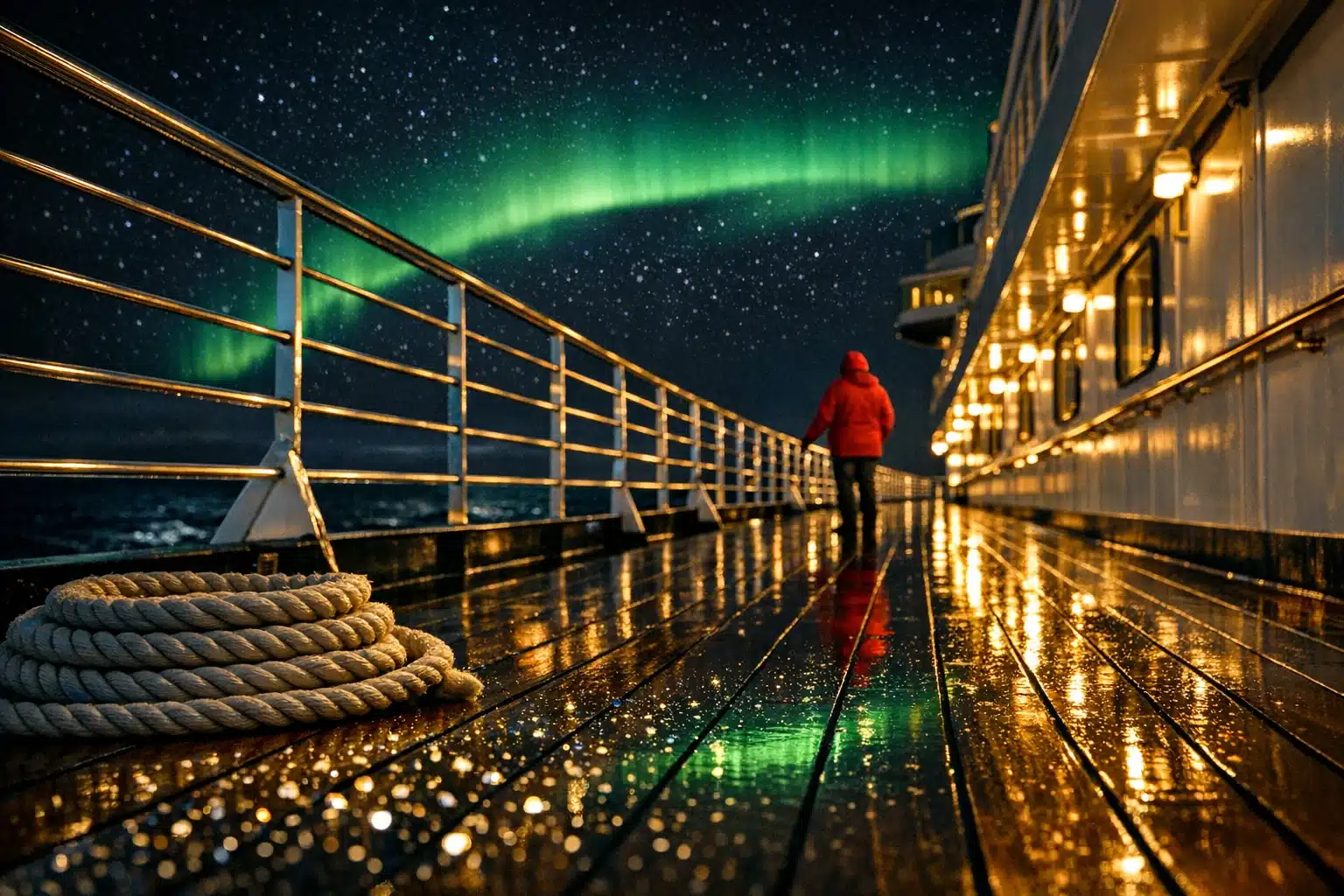
The upper deck is where the cruise becomes most memorable. On a clear night, the darkness out at sea can feel enormous. The wind is sharp, the air is cold enough to make conversation short, and the horizon seems to dissolve into a single black line. Even without aurora activity, there is a thrill in standing under a sky that feels much larger than the one most people see at home. When lights from towns and roads disappear, ordinary stars begin to look newly important.
That said, this is not a silent expedition ship staffed by astronomers at every railing. A short cruise from Hull is still a mainstream leisure product. You may see couples on a winter break, older travellers enjoying the maritime setting, and first-time cruisers testing whether sea travel suits them. The best way to enjoy the experience is to combine curiosity with flexibility: enjoy the ship, enjoy the route, and treat any aurora sighting as a remarkable bonus rather than the only reason the trip has value.
3. Northern Lights Chances: Science, Seasonality, and Setting Realistic Expectations
The Northern Lights, or aurora borealis, occur when charged particles from the sun interact with gases in Earth’s upper atmosphere. Those collisions can produce curtains, arcs, or rippling bands of light, most often green, though pink, red, and violet can appear under the right conditions. It is one of the planet’s most compelling natural displays, but it is also famously unreliable. No operator can promise a sighting, and that is especially true on a two-night route from Hull, where time and geography both limit your odds.
To see the aurora clearly, several factors need to line up at once. You need darkness, reasonably clear skies, adequate geomagnetic activity, and a viewing position far enough north to improve the probability of solar activity showing up overhead or near the horizon. Northern Norway, especially places around 69 to 71 degrees north, is widely known as one of Europe’s strongest aurora regions. Southern or lower-latitude parts of Norway can still see displays, but usually during stronger geomagnetic events. A short cruise that does not reach far north may therefore offer possibility rather than probability.
In broad terms, your viewing conditions are shaped by:
- Season: late autumn to early spring offers the longest hours of darkness
- Latitude: farther north generally means better aurora odds
- Cloud cover: a perfect solar event means little under a fully overcast sky
- Moon phase and onboard lighting: darker surroundings help weaker displays stand out
- Patience: some auroras appear briefly, then vanish before many people even reach the deck
This is where honest comparison helps. A land-based stay in Tromso, Alta, or the far north gives you several nights, local forecasting, and the ability to move inland if the coast is cloudy. A longer expedition-style cruise gives you more time at high latitude and more nights available for observation. A two-night sailing from Hull cannot compete with those formats on pure aurora statistics. What it can offer is ease, affordability relative to some Arctic itineraries, and a genuinely atmospheric way to watch the winter sky from open water.
There is also one underrated advantage to being at sea: very low light pollution once the ship is away from shore. If skies clear and solar activity is strong enough, a weak display may become visible where urban observers would see nothing. Still, ship lighting, weather exposure, and the ship’s route all affect the experience. You may need to stay awake late, check the deck more than once, and accept that the best sighting could last only minutes.
The right mindset is not cynical but informed. Treat the aurora as a chance event layered onto an already enjoyable voyage. If the sky erupts in green ribbons above cold water, the memory will feel almost unreal. If it does not, you can still return having experienced winter sailing, Norwegian seascapes, and the peculiar pleasure of watching the night from the deck of a moving ship. On a trip this short, realism is not a mood killer; it is what allows the magic, if it comes, to feel genuine.
4. Planning the Trip Well: What to Pack, What to Budget, and What to Check Before You Book
Short cruises often tempt travellers into underplanning because the trip seems simple. In reality, a two-night winter sailing rewards preparation. The better organised you are, the more comfortable the experience becomes, especially if conditions turn cold, windy, or rough. Start with the basics: confirm boarding times, passport validity, travel insurance, baggage rules, and any current entry requirements for Norway that apply to your nationality. Rules can change, so it is worth checking official sources close to departure rather than relying on memory or second-hand advice.
Packing for this trip is really about layering. Deck time is often the highlight, but it can be bitterly cold once the ship is fully exposed to North Sea winds. Fashion loses its authority quickly when you are trying to photograph the sky with numb fingers. A practical packing list usually includes:
- A windproof and waterproof outer layer
- Warm mid-layers such as fleece or wool
- Hat, scarf, and insulated gloves
- Non-slip shoes or boots suitable for wet decks
- Any motion-sickness remedies you trust
- A power bank, camera, or binoculars if you enjoy viewing details
Budgeting is another area where expectations should be realistic. The base fare may look attractive, but the full cost often includes cabin upgrades, meals beyond the standard offering, drinks, parking or rail travel to Hull, travel insurance, and optional extras. On a short cruise, an upgraded cabin or dining package can shift the total noticeably because the overall trip is so compact. That does not mean extras are poor value. It means you should decide early what matters most to you. Some travellers spend more for an outside cabin and skip premium dining. Others keep the cabin basic and treat themselves to better meals or a drinks package.
If you hope to photograph the aurora, remember that a moving ship makes things harder. On land, photographers often use a tripod and long exposure. At sea, ship movement can blur images, especially with weaker displays. Modern phones and compact cameras can still capture atmospheric night scenes, but expectations should stay flexible. Sometimes the best souvenir is not the perfect shot but the memory of being on deck in the freezing dark while everyone around you looks upward in silence.
Finally, check the small print of the itinerary. Does the cruise guarantee time in Norway, or is the emphasis primarily on sailing? Are weather-related route changes possible? Is the trip sold as a general winter cruise with aurora potential, or as a special themed departure? Those questions help you judge value accurately. When the planning is done well, the whole break feels easy: you arrive at Hull prepared, board with confidence, and spend the trip enjoying the experience rather than solving preventable problems.
5. Is It the Right Choice for You? Comparing This Cruise with Longer Sailings and Fly-and-Stay Trips
The best way to judge a 2-night Northern Lights cruise from Hull is not to ask whether it is the ultimate aurora holiday. It is not. The better question is whether it matches your travel style, budget, and appetite for winter adventure. For some people, it absolutely does. If you live within reasonable reach of Hull, prefer avoiding airports, and like the romance of sea travel, this kind of break can feel refreshingly straightforward. You board, unpack once, let the ship do the work, and enjoy a compact escape that still has a sense of occasion.
This cruise tends to suit a few specific types of traveller very well:
- Couples looking for a winter mini-break with a scenic edge
- First-time cruisers who want to test whether they enjoy life at sea
- Travellers with limited annual leave who still want a distinctive cold-season trip
- People based in northern or eastern England who value port convenience
- Holidaymakers interested in the aurora but not ready to commit to a longer Arctic itinerary
By contrast, it may be less suitable for photographers whose main goal is strong aurora coverage, families expecting a long list of shore excursions, or travellers who become uneasy in rough weather. A two-night sailing leaves little time to recover from poor conditions or a cloudy night. If your priority is the highest possible chance of seeing the Northern Lights, a fly-and-stay trip to northern Norway, Swedish Lapland, or Finnish Lapland is usually the stronger choice. Several nights in one location give you repeat opportunities, local guides, and the option to move away from cloud or coastal weather.
Longer Norwegian cruises also occupy a different category. A five- to seven-night sailing can offer deeper coastal scenery, more varied ports, and potentially better aurora positioning. The trade-off is cost, time, and commitment. Flights are faster but come with airport procedures, baggage restrictions, and sometimes connections. A short cruise from Hull sits neatly in the middle: less intense than an Arctic expedition, more immersive than a quick city break, and often easier logistically than assembling a northern itinerary on your own.
There is also something to be said for the emotional scale of the trip. Not every holiday needs to be a grand campaign. Sometimes a brief departure from routine is enough. You leave familiar streets behind, trade traffic for open water, and spend two nights in a setting where the sky suddenly feels important again. That experience has value even when the aurora remains hidden behind cloud.
So who should book it? Travellers who understand the balance. Go for the sea crossing, the winter atmosphere, the novelty of approaching Norway by ship, and the possibility of seeing the lights. If those elements sound appealing in their own right, this cruise can be a smart and memorable choice. If your heart is set on maximising aurora odds above everything else, a longer and farther-north journey is the more logical investment.
Conclusion for Weekend Aurora Seekers
A 2-night Northern Lights cruise from Hull to Norway works best for travellers who want a short, distinctive winter break rather than a guaranteed sky-chasing expedition. Its strengths are convenience, maritime atmosphere, dark-sea scenery, and the simple pleasure of reaching Norway without the usual airport routine. Its limitation is equally clear: with only two nights and a relatively short route, your aurora chances are real but modest compared with longer trips farther north. If you book with that balance in mind, you are far more likely to enjoy the voyage for what it is. For curious couples, first-time cruisers, and anyone craving a compact cold-season escape, it can be a rewarding way to taste the drama of northern travel.